
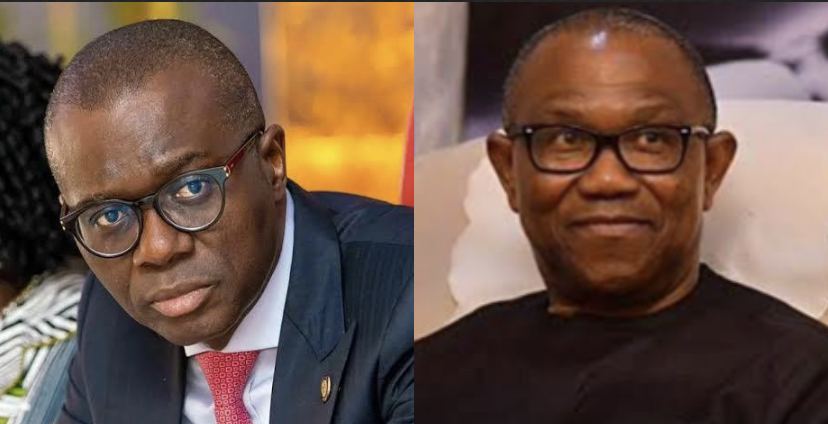
Sanwo-Olu and Peter Obi
By Simon Kolawole
There was an outbreak of controversy recently over statements made by Mr Peter Obi, presidential candidate of the Labour Party in 2023, about Nigeria at an international forum. Speaking at the Johns Hopkins University in Baltimore, Maryland, the US, Obi compared poverty statistics in Nigeria to those of Vietnam and China. He said more people were getting poorer in Nigeria whereas the other countries had pulled millions of their citizens out of poverty. Obi said: “The question then is, what exactly did these countries do to be able to achieve the desired growth and development? That is where political leadership comes in. These nations, unlike Nigeria, have competent leadership.”
Many Nigerians kicked, pointing out that his statements at foreign events often paint the country in bad light. Governor Babajide Sanwo-Olu of Lagos state angrily accused Obi of having a “disturbing pattern of behaviour” which “de-markets Nigeria” abroad. Sanwo-Olu said: “Obi made unflattering remarks not just about the incumbent Nigerian government, but also about Nigeria. I also find Mr. Obi’s pattern of behaviour disturbing. When prominent Nigerians go overseas, they ought to project Nigeria positively. They do not have to do that for the government. But we all owe a duty to market Nigeria on the global stage rather than de-market her. That is what true patriotism is about.”
Sanwo-Olu accused Obi of contributing to the poverty problem, adding: “I find it somewhat ironic that a man like Mr. Obi, who did not build a single school or a stand-alone hospital throughout his eight-year tenure as governor of Anambra, or sustainably provide credit facilities, would criticise the government of Nigeria which is actively doing that.” Obi has defended himself, maintaining that he was only telling the hard truth about Nigeria. “World Bank has just shown that 75% of Nigeria in rural areas are poor. Is World Bank demarketing Nigeria?” he fired back. Obi also pointed to UNICEF’s statistics which say Nigeria has the second-highest number of malnourished children in the world.
Interestingly, I very much understand Obi’s position as well as Sanwo-Olu’s reaction. I have a story to tell. While I was studying for a master’s degree at the University of Sussex in the UK in 2005, I had experiences that challenged my takes on Nigeria. My classmates were from all over the world — Ghana, Kenya, Mexico, Argentina, Italy, India, Estonia, the US, Japan and Azerbaijan. Holding seminars with students and teachers who had different worldviews and reading assorted academic essays by authors who had conflicting positions broadened my horizon and made me conclude that the world is actually not as simple as black and white. We tend to ignore grey and its many shades.
My first challenge was: how do I present my country to the world truthfully and wisely? Should I deceive myself by lying that everything was going well and we were on the right track? Should I tell the “hard truth” by washing our linen before foreigners, thereby further reinforcing the global cynicism about Nigeria? As time went by, I realised that my classmates, including the ones from other African countries, were discussing issues about their own countries with tact and optimism. They hardly uttered bad words about their countries even when we know they had serious challenges common to developing countries. They discussed their countries frankly but positively. I was amazed.
Until then, I had taken pride in highlighting all the bad things about Nigeria, particularly how corruption was stalling our development — all in an attempt to be “honest”. In fact, when I was about to choose a topic for my dissertation, my suggested topics revolved around corruption in Nigeria, but my supervisor, Professor Mick Moore, nudged me to write on something less sceptical, something that would contribute to the discourse on governance and development in my country. I came up with a proposal to do a research on informal sector taxation, with Lagos state as my case study. I got support from the Centre for the Study of the Future State, of which he was the director.
I had had a somewhat embarrassing experience during one of the seminars when I took a course on management of public finance. I was asked to make a presentation on tax reforms in Nigeria. The course conveyor was Charles Harvey, a professor of economics who had worked extensively in Africa. He helped in setting up Botswana’s central bank in 1975 and also lectured at the University of Botswana. He had enormous knowledge about Africa, having also worked in Zambia and Burkina Faso during his 30-year sojourn on the continent. I presented a case study of the reforms at the Federal Inland Revenue Service (FIRS), then led by Mrs Ifueko Omoigui. I thought I did a decent job.
But after all my sweat, Harvey announced: “Your problem in Nigeria is corruption. You have no reason to be where you are.” Should I say he was lying, especially when I had just received a text message from home informing me of the sharing of N50 million bribes at the National Assembly to get support for President Olusegun Obasanjo’s third term bid? In my weekly column, I myself had often been writing about corruption. I went mute, unable to decide the answer to give Harvey. He went further: “Is it true that your crude oil is stolen every day in connivance with government officials?” Should I say yes? Should I say no? I tried to play safe by saying: “It’s not impossible.”
I went away feeling like a hypocrite. There was nothing Harvey said about Nigeria that was a lie. But having seen how my colleagues were not badmouthing their own countries to prove that they knew how to speak the truth, I was beginning to recoil into my shell and was becoming more circumspect about the things I said about my country before foreigners. I realised along the line that if foreigners want to hear the most negative things about Nigeria, it is Nigerians themselves that will tell them. They don’t need to go asking Ghanaians or Kenyans. On our own, we will download everything, even more than they asked for. Anytime I read Wikileaks on the US cables concerning Nigeria, I cringe.
Our own Eedris AbdulKareem sang “Nigeria jagajaga” to speak “the hard truth” about his country (and I did not detect any lie in that song). King Yellowman, the legendary Jamaican reggae DJ, sang: “Jamaica nice! Jamaica nice! Jamaica nice!” Bob Marley sang lovingly about Trench Town. Peter Tosh reminisced adoringly about Westmoreland. Till today, Jamaicans sing about their country’s beautiful beaches and lovely islands. As a teenager, I longed to travel to Jamaica and even wanted to live there based on these songs. It was much later I realised Jamaica was also in the grip of poverty, drug abuse, gun violence and political turmoil — some morbidities you find in many developing countries.
While I was still struggling with how to present my country to foreigners during my time at the Institute of Development Studies (IDS) at the University of Sussex, I attended a one-day conference at the Said Business School, University of Oxford, in May 2006. It was put together by Oxford Entrepreneurs. The first session I attended was addressed by Mr Aigboje Aig-Imoukhuede, then MD of Access Bank Plc. He spoke on the topic: “From Ideas to Profits — An Investors’ Guide to Africa”. He narrated how his team bought the bank and transformed it in just four years. This, he said, was an indication of what the African economy had to offer to those with the ideas and the right attitude.
What I found quite interesting in Aig-Imoukhuede’s presentation was that he took time to highlight Africa’s problems. He did not shy away from facing the truth. He listed the problems associated with the legal system, financial system, economic and social indicators, political stability, infrastructure, human capital and bureaucracy. At a stage, I was like: “Isn’t this guy discouraging investors?” But he was obviously setting the stage for how to transform the problems to prospects and prosperity. These same problems actually offer opportunities for the world to invest. He listed fertile areas for investment as infrastructure, agribusiness, telecoms, tourism, finance and natural resources.
“Africa, with a population of 800 million people, is the second largest continent,” he elucidated. “There is growing demand and limited competition. It is an emerging market, far from mature. Africa is a virgin market. It is untapped. Currently, only about 1% of the private capital in the world is invested in sub-Saharan Africa, yet African markets easily outperformed the world averages last year and over the past three years. Africa currently offers the highest returns on foreign direct investment of any region in the world and African stock markets have soundly outperformed the S&P 500 in last four years. Egypt topped the global table. Ghana’s stock market was the world’s third-best in 2005.”
Aig eventually narrowed down to Nigeria, citing the telecoms sector as a clear evidence of the “hungry” nature of African market. “Nigeria has witnessed tremendous growth in tele-density from about one million GSM subscribers in 2001 to about 22 million by December 2005. MTN is Africa’s (Sub-Sahara) fastest growing telco with nine million subscribers in four years. IBTC Equity Fund is Nigeria’s largest and most successful mutual fund with over 163% returns since 1999. Citibank Nigeria is most profitable Citigroup franchise in Africa. It accounts for 20% of Citigroup’s Africa operation,” he said. He ended his presentation with a battle cry: ignore Africa at your own peril!
As I boarded the train on the three-hour journey from Oxford back to Brighton, I was a happy man. I had finally found a way out of my dilemma. I felt I could now talk about Nigeria without being apologetic or deceptive. I wouldn’t pretend that there are no problems. We have plenty problems. Embarrassing problems. But I would also not be so negative as not to talk about our little progress and the plenty opportunities that abound. Indian, Lebanese and Chinese entrepreneurs are all over Nigeria exploring opportunities and making billions. This same country. Truly, we cannot all see Nigeria the same way. But my conclusion remains that the world is not always either black or white.
Culled from TheCable

Leave a reply


The Editorial is a Platform for factual and precise news updates. Available to the readers 24/7 globally