
Tinubu meets with GENCOs, promises to resolve lingering debt issues
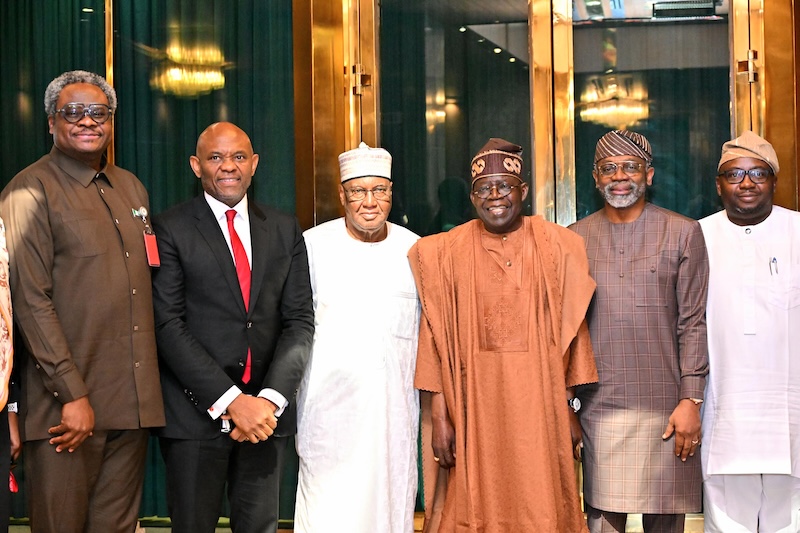
President Bola Tinubu on Friday appealed to power generation companies (GENCOs) to give the Federal Government more time to complete the verification and validation of longstanding debts owed to them.
A statement by Bayo Onanuga, the Special Adviser to the President on Information and Strategy, said this, adding that the President assured members of the Association of Power Generation Companies, led by Col. Sani Bello (retd), of his administration’s commitment to resolving the liquidity challenges in the power sector
During the meeting at the Presidential Villa in Abuja, the Special Adviser to the President on Energy, Mrs. Olu Verheijen, disclosed that a ₦4 trillion bond programme has received anticipatory approval from Tinubu to address the liquidity shortfall in the sector.
Tinubu acknowledged the historic liabilities inherited from previous administrations and pledged transparency and fairness in addressing them.
He said, “I accept the assets and liabilities of my predecessors, and there is no question about that. But that acceptance must be on credible grounds. I need to wear the audit cap of verifiability, authenticity, and the fact that this inheritance is not a mere deodorant but a support structure for critical economic and industrial promotion.”
The President emphasised the need for patience from GENCOs and financial institutions, noting that government agencies are actively engaging audit and legal firms to scrutinise the claims.
“We are here. So market it to your other colleagues. Give us time to do verification and validation of the numbers,” he added.
While reaffirming his belief in a market-driven electricity sector, the President said the industry’s long-neglected legacy issues are now receiving the attention they deserve.
Tinubu also emphasised the government’s commitment to creating a stable investment environment and avoiding extreme measures, such as bank asset foreclosures, against the generation companies.
“To our friends in the banking sector, I ask that we avoid foreclosures. Sharpen your pencils, but keep an eraser handy. Let’s persevere together,” he said.
Describing electricity as “the most important discovery of humanity in the last 1,000 years,” the President reaffirmed that access to electricity is fundamental to economic growth and human dignity.
The Special Adviser to the President, Ms. Verheijen, attributed the liquidity crisis to “a combination of unfunded tariff shortfalls and market shortfalls” that have built up over a decade.
She stated that as of April 2025, the Federal Government is carrying a verified exposure of ₦4 trillion in debts to GENCOs, an accumulation dating back to 2015.
Verheijen cautioned that the figure remains subject to downward revision, pending final validation.
The Minister of Power, Adebayo Adelabu, commended Tinubu for the attention given to the power sector, stating that the administration’s reforms have restored investor confidence and improved performance across the electricity value chain.
Adelabu recalled that the Tinubu administration signed into law the Electricity Act, 2023, which decentralises and liberalises the electricity market. This was the first legislation signed by the President upon assuming office.
He noted that the administration had launched Nigeria’s first Integrated National Electricity Policy in 24 years to drive coherence in sector planning and delivery.
He disclosed that over $2 billion in new private capital had been attracted to expand electricity access nationwide. At the same time, the sector’s annual revenue has grown by 70 per cent—from ₦1 trillion in 2023 to ₦1.7 trillion in 2024—resulting in a reduction of government subsidy obligations by over ₦700 billion.
He added that installed generation capacity has grown from 13,000 MW to 14,000 MW, with an all-time peak generation of 5,801 MW and a record maximum daily energy delivery of 120,370 MWh, achieved on March 4, 2025.
According to him, there has been no national grid collapse in 2025, a direct result of interventions under the Presidential Power Initiative, which has added over 700MW of transmission capacity.
Adelabu cautioned that the sector is grappling with an urgent liquidity crisis that could undermine the sustainability of ongoing reforms and investments.
“Mr. President, given the grave implications of this debt overhang, including the risk of a nationwide shutdown of generation assets, I humbly seek your immediate support for defraying these obligations, even if partially, over a defined period,” the Minister said.
In separate remarks, business leaders Tony Elumelu and Kola Adesina appealed for urgent intervention to preserve operations and encourage further investment in the sector.
“Mr. President, we’ve come to you as a last hope. The generating companies are heavily indebted to banks, and foreclosure threats are real, not because we’re not doing our jobs, but because the system owes us trillions,” Elumelu said.
Adesina reiterated the need for immediate liquidity support while raising concerns over gas supply shortfalls.
“Liquidity is the oxygen of our business. Without urgent intervention, generation capacity will stall, and Nigeria’s industrial and economic ambitions will be jeopardised.
“The plants in the Afam axis are underperforming because we have not paid gas suppliers. We propose unlocking 800 million cubic feet of gas through NLNG to boost supply to these power plants,” he said.
The meeting was attended by the Chief of Staff to the President, Femi Gbajabiamila; the Coordinating Minister of the Economy and Minister of Finance, Mr. Wale Edun; the Minister of Information and National Orientation, Alhaji Mohammed Idris; and other senior government officials, regulators, and stakeholders in Nigeria’s electricity industry.



Leave a reply


The Editorial is a Platform for factual and precise news updates. Available to the readers 24/7 globally