
Tinubu operating three budgets simultaneously while capital projects stall – ADC
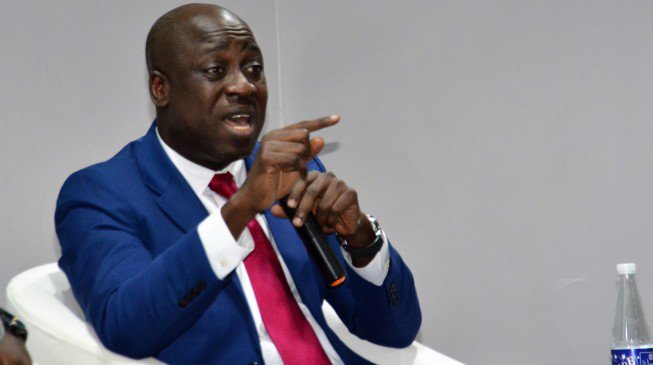
ADC National Publicity Secretary, Mallam Bolaji Abdullahi
The African Democratic Congress (ADC) has accused the President Bola Tinubu administration of operating three national budgets simultaneously without effectively implementing any of them.
On February 19, the senate queried the federal government’s economic team over the “persistent poor budget implementation”, particularly the low release of capital votes to ministries, departments and agencies (MDAs).
Days later, the senate committee on finance asked the Tinubu-led government to revert to the old payment system for contractors, citing mounting debts for projects executed in 2024 and 2025.
In a statement on Thursday, Bolaji Abdullahi, national publicity secretary of the ADC, said the development reflects the “utter confusion and a historic level of incompetence” in the management of public finances.
“The ADC has noted recent reports that signify utter confusion and a historic level of incompetence in the Tinubu administration’s implementation of national budgets since 2024,” Abdullahi said.
“This is the first time in Nigerian history that any government would be running three budgets at the same time while implementing none.”
Abdullahi said available reports indicate that the 2024 budget was rolled over into 2025.
He added that as of the third quarter of 2025, only 17.7 percent of the capital component of the budget had been released.
“Overall implementation hovered at less than 30 percent even as internal disbursements continued to lag,” he said.
Abdullahi dismissed the government’s explanation that the overlapping budgets were part of a strategy to complete multi-year capital projects.
“Government has argued that this absurdity is a ‘deliberate strategy’ and ‘transition cost’ to ensure that multi-year capital projects are completed,” he said.
“This is a blatant falsehood that cannot hold up to any scrutiny.”
The ADC spokesperson said 30 percent of the 2025 budget is expected to run from February 2026 to November 30, 2026.
He added that the remaining 70 percent has been rolled over into the 2026 budget currently under consideration by the national assembly.
“This situation becomes even more alarming when we recall that President Tinubu promised last year that all capital components of the 2024 and 2025 budgets would be concluded by March 31, 2026,” he said.
“Less than a month away, knowing quite well that this is not possible.”
Abdullahi also criticised the level of capital budget implementation in key sectors.
“As at today, capital budget implementation for the ministry of power stands at a mere 3.6 percent,” he said.
“That of communications technology stands at 8.9 percent, while education and health stand at 23.5 percent and 32.5 percent respectively.
“Certainly, no serious government would leave these sectors, which are crucial to national human capital development, largely unfunded while select government officials continue to live in obscene opulence in the midst of unprecedented poverty and human misery.”
Abdullahi said the ministry of defence recorded the highest budget performance at 113.45 percent due largely to emergency funding through the service-wide vote.
He added that insecurity has persisted despite the increased spending.
“Recent reports indicate that in this month of Ramadan alone, up to 500 Nigerians may have been killed by terrorists in Borno, Yobe, Adamawa and Kebbi,” he said.
Abdullahi also criticised the government’s borrowing and revenue management.
“This government has borrowed more aggressively than any other government in the country’s history,” he said.
“Yet budgets remain unimplemented and contractors remain unpaid.”
The former sports minister said the situation has worsened economic hardship across the country.
“This is the reason Nigerians are suffering like never before and asking the most important questions,” he said.
“What is this government doing with all the money that accrues from all the loans, all the revenues, and all the increased taxes? Why are we worse off today than we were three years ago?”
Abdullahi also accused the administration of reversing policy decisions and appointments.
“Since this government came on board, analysts have identified at least seven appointments and several policy decisions that the government has announced and reversed either almost immediately or after public uproar,” he said.
“This is what happens when a government is distracted.”
He said the government appears more focused on politics than governance.
“The Tinubu government has proven that to them, everything is about politics and power for its own sake,” Abdullahi said.


Leave a reply


The Editorial is a Platform for factual and precise news updates. Available to the readers 24/7 globally