
Haven’t we seen this before? [OPINION]
By Simon Kolawole
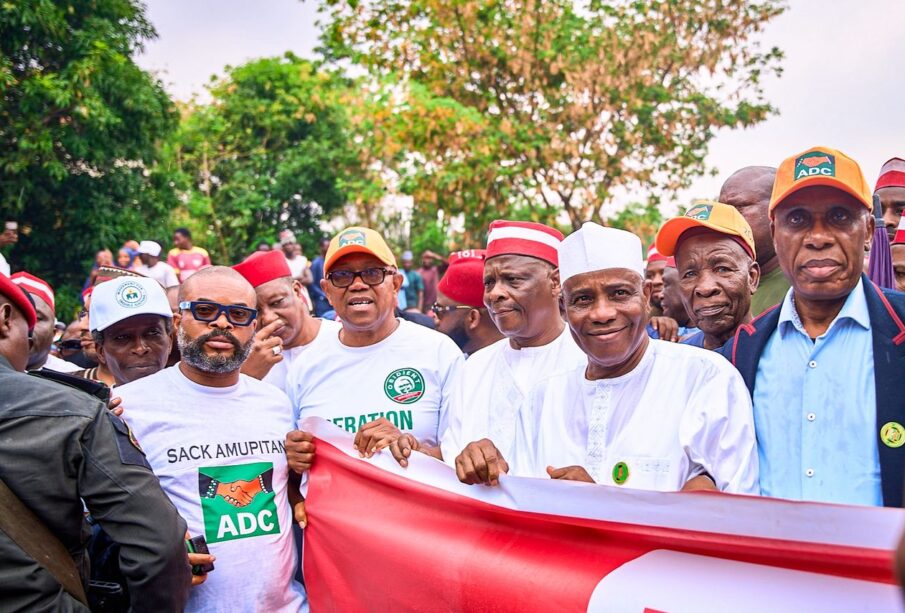
The Independent National Electoral Commission (INEC) has stirred a furore in the polity with the derecognition of the David Mark-led national officers of the African Democratic Congress (ADC). Alhaji Nafiu Bala had challenged the Mark leadership in court, maintaining that he did not resign as deputy national chairman and that the resignation of Chief Ralph Nwosu as chairman in 2025 meant he was automatically his successor. Mark asked the Court of Appeal to stop the suit, arguing that the Supreme Court already ousted court jurisdiction in the internal affairs of political parties. INEC, in its own defence, agreed with Mark. The appeal court sent the case back to the lower court for trial and ruled that “status quo ante bellum” be maintained. That is the matter we have been trying to settle.
What is “status quo ante bellum”? INEC said it means… wait, what did INEC even say? The commission said it does not want to recognise any faction until the court cases are exhausted. When you go to the INEC website, the column for the names of ADC’s national officers is populated with “by court order”. Was that the status quo ante bellum? “Status quo ante bellum” means “before the start of hostilities”. Was “by court order” the status before the hostilities? I think not. As far as we know, hostilities started after INEC recognised Mark as chairman. Bala was at his inauguration. If hostilities started before then, we do not know. INEC has effectively destroyed the “res” of the lawsuit by derecognising Mark even before the trial court could grant or deny a declarative relief.
If we were to use some common sense here, what was before the appeal court was not the ADC leadership tussle. It was a challenge to the jurisdiction of the high court to entertain the matter since the Supreme Court had declared long ago, in a case involving the leadership crisis in the Peoples Democratic Party (PDP), that such internal matters are not for the courts to decide. But why did the appeal court order “status quo ante bellum” when nobody asked it for a declarative relief on the leadership tussle? Was the appeal court trying to assume the role of the trial court? I also found it laughable that Prof Joash Amupitan, the INEC chairman, suggested he was only being kind to the ADC with the derecognition to avoid a repeat of the Zamfara state fiasco of 2019. Yeah, right!
The ADC has been pointing accusing fingers at President Bola Tinubu and the APC over the crisis. Knowing how politics is played in Nigeria, I would not dismiss the allegation. In fact, I would expect Tinubu and the APC to take full advantage of the crisis to weaken the opposition. A cracked wall is an open invitation to a lizard to crawl inside. If I was in a position to advise the ADC leaders all along, I would have told them to accommodate Bala one way or the other. Even if to humour him, retain him as deputy chairman or something something “emeritus”. Burn all the bridges. What we are reading on social media — I can’t vouch for the authenticity, though — is that Bala felt snubbed and humiliated. The moment he became disgruntled, Tinubu and the APC would naturally smell blood.
When this whole saga started, I had a feeling of déjà vu. Nigeria seems to be permanently on auto replay. After his inauguration in May 1999, President Olusegun Obasanjo, who was elected on the platform of the PDP, immediately launched an operation to destabilise the opposition. First, he appointed Chief Bola Ige of the Alliance for Democracy (AD) as minister of power and steel, thereby sowing discord in the party that controlled the six south-west states. He thereafter appointed Alhaji Mahmud Waziri, chairman of the All Peoples Party (APP), as special adviser on inter-party relations. That, fellow Nigerians, marked the dawn of co-optation in the fourth republic. As at then, the APP (later rebranded All Nigeria Peoples Party, ANPP) controlled nine of the 19 states in the north.
Obasanjo had been thoroughly embarrassed in his native south-west in the 1999 presidential election: he did not win a single state. The AD/APP alliance won all. Ahead of the 2003 elections, he sowed strife in the AD, capitalising on Ige’s bitterness that Chief Olu Falae was preferred to him in the nomination of the party’s consensus presidential candidate in 1999. As soon as Obasanjo saw the crack in the wall, he crawled into it with his full chest. Ige accepted the cabinet appointment without recourse to Afenifere, the pan-Yoruba group that used to call the shots in the AD. Obasanjo also appointed Mrs Modupe Adelaja, daughter of Chief Abraham Adesanya, the Afenifere leader, into his cabinet. Their hands became tied. But that was just the introduction to the Obasanjo blitzkrieg.
Ige began to demolish Afenifere. He organised a rival group, the Yoruba Council of Elders (YCE). An AD faction led by Comrade Adamu Song suddenly surfaced in November 1999, claiming to have taken over the party and announcing the dissolution of the national executive committee (NEC) led by Amb Yusufu Mamman. The crisis dragged on for ages. A frustrated Mamman issued a statement in November 2000 accusing Obasanjo of trying to turn Nigeria “into a one-party state”. He also accused Ige of plotting to carve out a section of the AD to guarantee Obasanjo a second term. “Obasanjo will stop at nothing to destroy the little democratic gains of the past 17 months on the altar of his ambition to rule Nigeria for a second term, and become, possibly, president for life,” he alleged.
INEC had boycotted the November 2000 Afenifere/Falae convention that produced Mamman, preferring to recognise the one by the Ige/Song faction which elected Alhaji Adamu Ahmed Abdulkadir as chairman. Despite recognising Abdulkadir, Dr Abel Guobadia, the INEC chairman, still wrote to Mr Ufot Ekaette, the SGF, in February 2001 to declare that the AD was in factions. Section 68 of the 1999 constitution allows defectors to keep their elective positions if their party is divided. That Guobadia letter set the stage for the defection of three AD senators — Wahab Dosunmu (Lagos West), Yemi Brimo-Yusuf (Oyo North) and Fidelis Okoro (Enugu North) — to the PDP in May 2001. This, I believe, started a troublesome tradition in this era. Defections are now two for one kobo.
While Obasanjo continued to empower PDP members in the south-west to get a hold on the region ahead of 2003 elections, he also made sure to trick the AD into not fielding a presidential candidate. Gen Muhammadu Buhari’s stock was rising in the north as Obasanjo was accused of marginalising the region. Some important northern leaders in the PDP also said Obasanjo had promised to serve only one term in office. In the south-east, the clamour for an Igbo president was gathering pace, with the Movement for the Actualisation of the Sovereign State of Biafra (MASSOB) threatening secession. Meanwhile, the All Progressives Grand Alliance (APGA) was also formed to seek power shift to the south-east. Obasanjo’s second-term bid could end up in flames if the AD did not support him.
Obasanjo successfully sold these sentiments to the AD and Afenifere, who then agreed not to field a presidential candidate in order to boost his chances, but they also asked that all AD governors be returned. By the time the elections were done and dusted, the war-time general had outsmarted them all. He won all six AD states, getting over 92 percent in five of them. The PDP also captured the governorship in five of those states, leaving only Lagos for Tinubu. Actually, they did not willingly leave it: on the INEC website, Mr Funsho Williams, the PDP candidate, had been briefly declared winner. The full story is yet to be told. While AD leaders were bitter with Obasanjo, Abdulkadir openly rejoiced with him. And Obasanjo appointed Abdulkadir as special adviser on manufacturing.
Long story short, by the time Obasanjo left office in 2007, the PDP had taken control of 30 states. The AD and ANPP were gasping for breath. From 1999 to 2015, the PDP tried to stifle opposition. In 2006, Tinubu left the AD to found Action Congress. Buhari quit the ANPP to set up the Congress for Progressive Change in 2009. To their credit, both men remained steadfast as opposition. This eventually led to the birth of the APC in 2013. The rest is history. It is disheartening that our democracy is going round in circles — as if on auto replay. Interestingly, most of the ADC leaders today are PDP veterans who played this subterfuge game before. I expect them to plot their own countermoves. A strong opposition, no matter the obvious contradictions, is good for democracy.
Cullee from TheCable


Leave a reply


The Editorial is a Platform for factual and precise news updates. Available to the readers 24/7 globally