
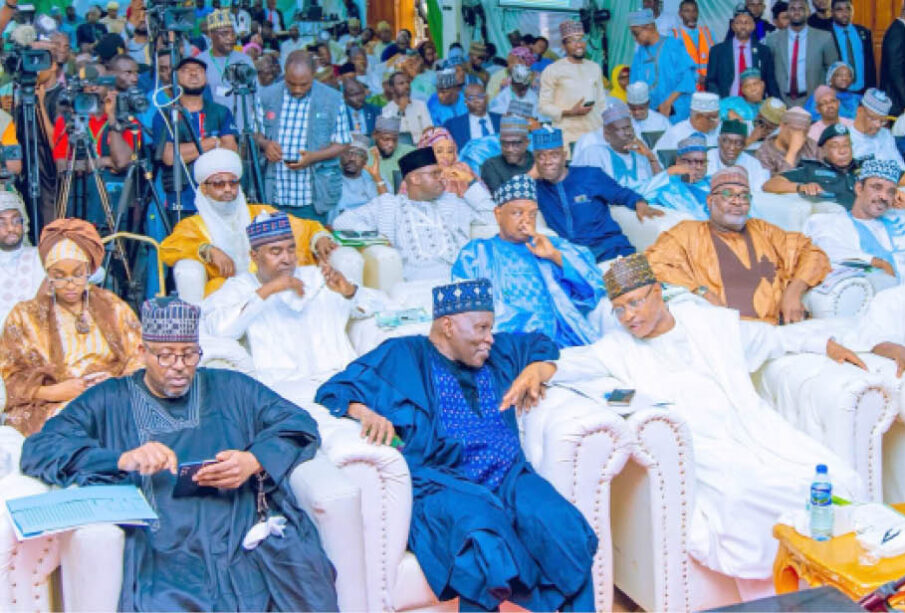
From left: Former Niger, State governor, Babangida Aliyu; former FCT Minister and Presidential Adviser, Dr Aliyu Modibbo (representative of Vice President Kashim Shettima); Gombe State governor, Muhammadu Inuwa Yahaya; Kaduna State governor, Senator Uba Sani; and Secretary to the Government of the Federation (SGF), George Akume, during the two-day interactive session on government-citizen engagement, organised by the Sir Ahmadu Bello Memorial Foundation (SABMF), held at Arewa House in Kaduna, on Tuesday
The Arewa Consultative Forum (ACF) has raised concerns over the alleged marginalisation of Northern Nigeria in federal budget allocations and infrastructure development under the administration of President Bola Tinubu.
Speaking at a two-day citizen engagement forum organised by the Sir Ahmadu Bello Memorial Foundation in Kaduna on Tuesday, Alhaji Bashir M. Dalhatu, Wazirin Dutse and Chairman of the ACF Board of Trustees, claimed that the region has been sidelined in critical policy decisions and project implementation despite what it called its significant electoral support for the president in the 2023 general elections.
The event, themed; “Assessing Electoral Promises: Fostering Government-Citizens’ Engagement for National Unity,” brought together governors, top federal government officials, including ministers, traditional rulers, and members of civil society.
According to the organisers, the meeting aimed to strengthen inclusive governance by facilitating structured dialogue between policymakers and citizens across Northern Nigeria.
Sources, who spoke to Daily Trust, said the federal government may have partnered with the foundation to highlight the achievements of the Tinubu administration in the North, amid complaints from several quarters within the region over alleged marginalisation. This, according to the sources, is evidenced by the array of the president’s appointees and members of the ruling party who were present at the event.
The event had in attendance a representative of Vice President Kashim Shettima; George Akume, Secretary to the Government of the Federation (SGF); Nuhu Ribadu, National Security Adviser; Governors AbdulRahman AbdulRasaq (Kwara); Muhammad Inuwa Yahaya (Gombe) and Uba Sani (Kaduna).
Ministers at the event included Badaru Abubakar, Minister of Defence; Bello Matawalle, Minister of State for Defence; Mohammed Idris, Minister of Information; Muhammad Bello Goronyo, Minister of State for Works; Yusuf Abdullahi Ata, the Minister of State, Housing and Urban Development; Mariya Mahmoud Bunkure, Minister of State, FCT. Also in attendance were the Chief of Defence Staff, Gen. Christopher Musa, Chief of Air Staff, Hassan Abubakar and Comptroller General of the Nigerian Immigration Service, Kemi Nandap.
Former governors at the event included; Ramalan Yero (Kaduna), Aliyu Shinkafi (Zamfara), Ibrahim Shekarau (Kano) and Babangida Aliyu (Niger) among others.
The Sir Ahmadu Bello Memorial Foundation was established in 2009 by the 19 Northern state governors, in collaboration with associates and family members of Sir Ahmadu Bello, the late Premier of the Northern Region and Sardauna of Sokoto.
Its mission is to preserve and promote the ideals, values, and legacies of Sir Ahmadu Bello, particularly in areas such as education and leadership development, good governance and transparency, health and agriculture, entrepreneurship and peace building and religious and ethnic tolerance.
The foundation is headquartered in Kaduna, Nigeria, and operates as an Incorporated Trustee under registration number IT-30957.
Key initiatives include scholarships to 200 students from the 19 Northern states and the FCT, focusing on science and technology disciplines, Health Outreach, Agricultural Empowerment, Vocational Training and Annual Memorial Lecture.
The foundation’s board of trustees is composed of Northern leaders, academics, traditional leaders, and civil society advocates, including Dr. Mu’azu Babangida Aliyu, former governor of Niger State (chairman), Mallam Ibrahim Shekarau (Former Kano State governor) and Dr. Abubakar Gambo Umar (Director-General & CEO).
The ACF leader, Alhaji Bashir Dalhatu, noted that the North, which delivered over 64% of President Tinubu’s total votes, has been “largely excluded” from key governance processes.
His remarks echoed earlier criticisms from northern political figures who accused the administration of favouring the South in both federal appointments and major infrastructural developments.
The ACF Board of Trustees chair said the North, which contributed over 64% of Tinubu’s total votes in the 2023 general elections, has been largely excluded from critical policy decisions and project implementation.
“Two years into President Tinubu’s four-year tenure, the feeling among the people of the North is, to put it mildly, completely mixed.
“To our surprise, those who did not support him, did not vote for him, and hardly wished him well have emerged from nowhere and are now attempting to drive a wedge between him and the North,” Dalhatu said.
Dalhatu cited federal budget figures to underscore the region’s alleged neglect, saying “For instance, of the N1.013 trillion allocated to roads in the current federal budget, only N24 billion — less than 1% — was earmarked for projects in the North East.”
Referencing a May 2025 press release from the Federal Ministry of Works, he added: “The regional breakdown is telling — South West received N1.394 trillion, South East, N205 billion, North West, N105 billion, and North East, just N30 billion. Sadly, this discriminatory practice is not hidden — it is now done openly, without apology.”
The ACF chairman decried what he called the lack of progress on strategic northern infrastructure projects, citing neglect in roads, railways, power supply, and agriculture.
“Unlike the Lagos-Ibadan Expressway or the Second Niger Bridge, not a single road of strategic importance to the North has been completed or properly maintained in the last twenty years,” he said.
Alhaji Bashir also criticised the federal government’s low budgetary allocation to agriculture despite Northern Nigeria’s critical role in national food and livestock production.
“Despite the apparent goodwill of the Tinubu administration, budgetary allocations to agriculture remain under 5%, far below the 25% recommended by the FAO,” he said.
He called on the president to urgently review his development priorities, fast-track key infrastructure like the Mambilla Hydroelectric Dam, Baro Inland Port, and Ajaokuta Steel Mill, and address what he described as “open marginalisation” of the region.
“President Tinubu should be persuaded to declare a state of emergency in the electricity sector. Without adequate power infrastructure, the North doesn’t stand a dog’s chance of economic development,” he said.
Dalhatu stressed the need for sustained dialogue between the federal government and Northern leaders.
“We commend today’s interactive conference. Many of these issues were raised during our visit to the president on May 30, 2024. Unfortunately, the ACF-FGN Contact Committee proposed at that meeting is yet to take off,” he said.
Yesterday’s complaint by the ACF is coming on the heels of similar allegations. Senator Rabiu Musa Kwankwaso, the 2023 presidential candidate of the New Nigeria Peoples Party (NNPP), had accused the President Bola Tinubu’s administration of favouring the South in development initiatives while neglecting the North.
Speaking at a stakeholders’ dialogue on the 2025 constitutional amendment in Kano, Kwankwaso decried what he described as a lopsided distribution of national resources.
“From the information available to us, most of the national budget now appears to be going in one direction. A government that takes resources from across the country and invests only in one part is not acting in the national interest,” he said.
Former Secretary to the Government of the Federation (SGF), Babachir Lawal, also criticised the federal government over what he called the lack of visible projects in the North. Speaking on Trust TV’s Sunday Politics, Lawal said: “No projects are going on—at least they are not visible to the eye. Maybe in their imagination, maybe in the spirit—but we don’t see them.”
Hakeem Baba-Ahmed, former Special Adviser on Political Matters to the President, criticised the North West’s political elite for supporting Tinubu while “neglecting the suffering of their people”. In a post on X, he wrote: “They forgot the people who will judge all politicians against their exposure to violence, death, and poverty. It’s almost as if they think people don’t matter.”
Baba-Ahmed, who resigned from his position in the presidency, warned that northern voters will hold their leaders accountable in 2027, for the region’s enduring insecurity and economic hardship.
Similarly, Hajiya Naja’atu Mohammed, a former member of the Tinubu campaign team, accused the president of running a government “by Yorubas, for Yorubas.”
Senator Ali Ndume of Borno South also raised concerns over federal appointments, citing Section 14(3) of the 1999 Constitution, which mandates fair regional representation. In April, Ndume described Tinubu’s appointments as “lopsided,” warning that continued imbalance could provoke political backlash.
However, following a wave of new appointments in May 2025—in which 12 Northerners were named to strategic federal positions—Ndume praised President Tinubu as a “listening leader,” saying the move corrected earlier imbalances.
The claim of marginalisation was, however, countered by the governors of Kaduna and Gombe states at the event yesterday. They maintained at the forum that Tinubu’s administration is committed to fulfilling its campaign promises to the North.
Secretary to the Government of the Federation (SGF), Senator George Akume, also reassured Nigerians that the Tinubu administration is determined to ensure equitable development across all regions, leaving no area behind.
Kwara State Governor AbdulRahman AbdulRazaq disclosed that President Tinubu postponed the weekly Federal Executive Council (FEC) meeting to enable all ministers, particularly those from the North, to participate in the citizen engagement in Kaduna, demonstrating the importance the presidency places on listening to the region’s concerns.
Also, the Minister of Information, Mohammed Idris, who introduced ministers, political advisers, and heads of agencies from the Northern Nigeria serving in the current administration, said about 60 northerners currently occupy key positions in government, disputing claims of marginalisation.
Idris said the presence of these officials at the event was a directive from the presidency, intended to reaffirm the federal government’s commitment to engaging citizens, especially in the North.
On his part, Ribadu said that security agencies had recorded a lot of achievements in the region including the killing of hundreds of bandits that were terrorising communities.
The Governor of Gombe State and Chairman of the Northern States Governors Forum, Inuwa Yahaya, on his part, declared that the North will support President Bola Tinubu’s bid for a second term in 2027, in recognition of his administration’s efforts in fulfilling key electoral promises to the region.
Yahaya said the overwhelming support Tinubu received from the North in the 2023 presidential election was a strategic decision that is already yielding tangible results in infrastructure, security, energy, and agriculture.
“When candidate Bola Ahmed Tinubu stood before us during the 2023 campaign, he made specific commitments to Northern Nigeria. The North, believing in his vision, voted strongly for him, contributing over 60% of his winning votes,” Yahaya said.
He maintained that President Tinubu’s administration has made steady progress despite economic and security challenges.
He said, “Today, we gather not for empty rhetoric but to examine those promises and assess the level of progress so far. What we find is an administration that has delivered meaningful results for our region despite facing significant national challenges. I make bold to say the evidence of progress is visible across our region.
“In 2027, we must reward performance and hard work, and by that measure, President Tinubu has earned our continued support.”
Yahaya described the alliance between the North and South-West as a stabilising force for Nigeria’s unity, citing the words of the late Sardauna of Sokoto: “The North’s strength lies in its unity with all Nigeria.”
To support his claims, he listed several federal projects, including the Abuja-Kaduna-Kano expressway, Kano-Katsina-Maradi rail line, the rehabilitation of the Kaduna refinery, the Abuja-Kaduna-Kano gas pipeline, and the continuation of drilling in the Kolmani oilfields.
“These projects promise to bring industrial growth and energy security to Northern Nigeria,” he said, adding that the Renewed Hope agenda is gradually turning long-standing ambitions into reality.
Beyond legacy projects, Yahaya highlighted emerging initiatives such as the Sokoto-Badagry superhighway, improved inter-state road networks, and increased investment in agriculture value chains across northern states.
He also cited ongoing upgrades in healthcare infrastructure as part of deliberate efforts to improve the well-being of the northern population.
The governor commended federal efforts in tackling insecurity, saying over 300 bandit kingpins and terrorist commanders had been eliminated through coordinated operations and improved intelligence gathering.
He also welcomed the creation of the Federal Ministry of Livestock Development, describing it as a “generational breakthrough” in modernising Nigeria’s pastoral economy.
Also speaking at the event, Kaduna State Governor Uba Sani accused prominent northern political leaders of shifting blame to President Tinubu for challenges that have long persisted under their watch.
He said the region’s problems — insecurity, poverty, and educational backwardness — were not created by the Tinubu administration, but worsened due to the negligence, silence, and inaction of northern elites over the past two decades.
Sani warned that the era of blame games must end, urging northern leaders to take ownership of the region’s crisis and work collaboratively with the Tinubu administration to find solutions.
He said the gathering was not a political jamboree but an opportunity to assess the promises made by President Tinubu, and more importantly, to evaluate the contributions or failures of northern stakeholders themselves.
“Yes, President Tinubu made promises. But let’s be honest with ourselves: he has kept faith with the North in many critical areas — security, agriculture, education, and economic inclusion. The real question is, have we kept faith with our people as northern leaders?” he asked.
He criticised the selective memory of some northern politicians who, he said, remained silent as the region’s socio-economic indicators plummeted — only to turn around and blame Tinubu after just two years in office.
“For over 20 years, insecurity grew, education declined, and poverty deepened. Where were the loud voices now blaming Tinubu when these issues took root? It is hypocrisy to shift responsibility to a government that inherited decades of rot,” the governor said.
Sani said no president, no matter how visionary, could solve the North’s problems without active collaboration from state governments, traditional rulers, and local communities.
“We must stop waiting for Abuja to solve every problem. The North must rise and take charge of its own destiny,” he said.
Recalling the dire security situation in Kaduna before assuming office in 2023, Sani said the state had been “almost overrun” by bandits and terrorists, with the Abuja-Kaduna expressway becoming a national symbol of insecurity.
He noted that his administration introduced the “Kaduna Peace Model” — a hybrid security and governance framework combining military operations, local vigilantes, community dialogue, and institutional reforms — which, he said, had started yielding results.
“If we had organised this same event last year, this hall would have been empty. People would have stayed away in fear.
“Today, our rural areas are returning to life. Displaced communities are gradually coming back. Federal support and local innovation made this possible,” he said.
Governor Sani credited President Tinubu for initiating programmes that are already benefiting Northern Nigeria, particularly in education and agriculture.
He commended the student loan scheme and the push for vocational education, which he said are equipping Northern youth with employable skills.


Leave a reply


The Editorial is a Platform for factual and precise news updates. Available to the readers 24/7 globally