
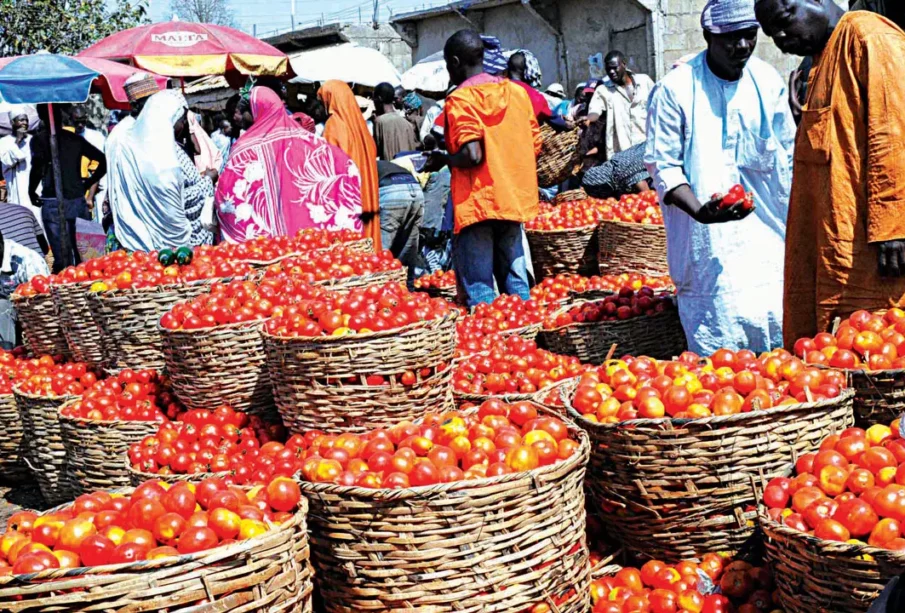
Basket of tomatoes
Tomato farmers in Kano, Katsina, Kaduna, Plateau and other states are currently grappling with severe glut as the harvest season begins.
After the catastrophic Tuta absoluta outbreak ravaged crops and inflicted billions of naira in losses on the tomato industry, farmers now face another daunting challenge.
Daily Trust correspondents across the states report that markets are now flooded with fresh tomatoes, leading to a sharp drop in price and heavy financial losses for farmers who had invested heavily to recover from previous setbacks caused by the pest attack.
Over the past few years, infestations of Tuta absoluta, a highly damaging tomato leaf miner, have wreaked havoc on farms in northern tomato-growing regions.
These outbreaks have led to the destruction of vast areas of cultivated land, compelling numerous farmers to cease production. The disruptions have significantly impacted supply chains and driven many farmers into financial distress due to mounting debts.
In 2016, the first outbreak of Tuta absoluta devastated tomato crops in seven northern states: Jigawa, Kano, Katsina, Kaduna, Plateau, Gombe and Nasarawa. Subsequently, it has also been detected in two additional states in the South-West region: Lagos and Oyo.
In Kano State, Malam Abba Ibrahim Kalla of Bunkure Local Government Area, told Daily Trust that going back to the farm was very difficult as he had incurred a huge loss in his tomato farm last year due to the pest attack.
He added that it was with the assistance of a loan he got from his associates that he was able to return to the farm this dry season.
Malam Kalla noted that despite the recent commencement of the harvest season, early signs indicate that farmers are likely to face losses due to tomato surplus in the market, which inevitably leads to a sharp decline in the price of tomatoes.
Daily Trust correspondent who visited some tomato markets revealed that a full basket of tomatoes is now selling at less than N10, 000 while a crate is selling at less than N3, 000, which many farmers said was far below its production price.
A basket of tomatoes, which once fetched over N25,000, now sells at a fraction of that price. Farmers lament their inability to recoup expenses for fertiliser, seeds, chemicals, labour and transportation.
Another farmer, Idris Muhammed, said tomato farmers appreciated the commitment of research institutions and other agencies in tackling the Tuta problem, enabling many farmers to hone their skills in combating this pest, instilling confidence in them to invest more heavily in tomato cultivation this year.
He explained that farmers had eagerly cultivated tomatoes this year, but they faced an unfortunate glut in most markets across the growing areas.
“With improved pest control measures and renewed confidence, many farmers returned to tomato cultivation this season. Ironically, the rebound in production has now resulted in excess supply, outpacing market demand, resulting in the glut we are witnessing now,” he said.
In Kaduna State, farmers raised serious concerns over the rising cost of fertiliser, recurring tomato diseases, poor storage facilities and unstable electricity supply, warning that the challenges are threatening their livelihood and the sustainability of tomato production in Nigeria.
A tomato farmer in Hunkuyi town, Kudan Local Government Area of Kaduna State, Alhaji Auwal Ibrahim Hunkuyi, said the high cost of fertiliser was gradually crippling tomato farming.
Speaking with Weekend Trust, Alhaji Auwal lamented that “this year, tomato farming faced many challenges and the price of tomatoes collapsed in the market. But what worries us most is the high cost of fertiliser. That is the real problem facing tomato farmers.
“Today, a bag of fertiliser is sold at N50,000, yet you end up selling tomatoes at N1,700 to N3,000 per kilogram. That alone shows that something is seriously wrong.”
Alhaji Auwal explained that many farmers were forced to continue farming, not because it is profitable but because it is their only means of survival.
“We are farming now because we need food, not because of profit. If you spend N1 million on a farm, it is very difficult to make N200,000 profit,” he said.
He further broke down the rising cost involved in tomato production, including fuel for irrigation machines, agrochemicals, labour and fertiliser.
He explained, “When you calculate the cost of petrol for irrigation engines, chemicals for spraying, payment for labourers and the cost of fertiliser, you will not even make N200,000 profit. In fact, most times, you run at a loss.
“Last year, a bag of maize was sold at N60,000, but now, it has dropped to N18,000. With that same money, you farm tomatoes, and at the end of the season, people come and buy it at N3,000 per kilo. Where is the profit in that?”
He added that the situation made it appear as if farmers were only working for fertiliser dealers.
Meanwhile, the assistant chairman of the Tomato Leda Cooperative Societies and Sellers at Mugadishu Market, Kaduna, Hafiz Umar, said tomato supply had improved due to a reduction in pest infestations, largely because of the cold season.
“There is improvement now because it is the cold season. The tomato pest problem has reduced significantly,” he said.
Hafiz recalled that in previous years, the situation was worse, forcing traders to seek tomatoes outside Nigeria.
“It was not like this in the past. There was a time when tomatoes almost disappeared completely. We even had to travel to Cameroon to buy tomatoes because there were none in Nigeria,” he said.
According to him, the worst period is usually between March and May.
“From March to April and May when the weather is very hot, we face serious problems with tomato pests. But now, because we are in the cold season, there is much improvement,” he said.
On the current market prices, Hafiz Umar said tomato prices dropped significantly.
“At the moment, a basket of tomato sells at N10,000. A rubber container sells at N3,500 to N4,000, while a small nylon (leda) sells at N500 to N1,000,” he said.
He compared the prices with what was obtainable last year during the hot season.
“Last year, during the hot season, we sold a basket at N60,000 to N100,000. A rubber container was N15,000 to N30,000, while a nylon was N5,000 to N10,000,” he recalled.
The women leader of Tomatoes Market at Cele Bridge in Jos, Plateau State, Ruth Izang, told our correspondent that tomato price had really crashed, adding that many people are still blaming it on the disease that has refused to leave the farms in the state.
“The price of good tomatoes, the variety travellers prefer, is around N5,000 for a basket, while the price of other varieties that have shorter shelf life ranges between N4,000 and N3,000.
“Around November and October last year, it was sold at N17,000, N16,000 and N15,000.
“Another reason for the tomato price crash in Plateau State is because tonnes of the commodity are being flooded in the market from Zaria,” she said.




Leave a reply


The Editorial is a Platform for factual and precise news updates. Available to the readers 24/7 globally