Food spending drops by N3tn, as cash crunch worsens
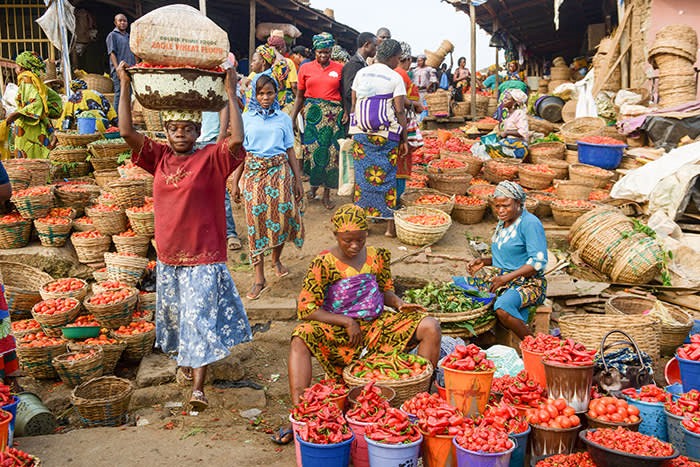
A Nigerian food market... Photo: File
Nigerians spent N3.05tn less on food and other household consumption in the first half of 2023.
When adjusted for inflation, Nigerians spent N21.78tn on household consumption of goods and services, a 17.32 decline from the N24.84tn they spent in the corresponding period of 2022, according to the National Bureau of Statistics ‘Nigerian Gross Domestic Product Report (Expenditure and Income Approach): Q1, Q2,’ report released on Thursday.
Based on the NBS report, the amount spent by households on goods and services rose to N61.08tn in nominal terms (current purchasers’ value). However, when adjusted for inflation (at 2010 purchaser’s values), a real reflection of actual value, household consumption fell, weighed down by worsening economic conditions.
Household consumption expenditure consists of expenditure, including imputed expenditure, incurred by resident households on individual consumption goods and services, the statistics body explained.
Commenting on household consumption in real terms (at 2010 purchaser’s values), the NBS said, “Household final consumption, in real terms, grew by -24.95 per cent and 3.30 per cent in Q1 and Q2 of 2023 respectively, on a year-on-year basis.
“Moreover, the growth rate of Q1 of 2023 was lower compared to the growth rate of the corresponding quarter of 2022 which was 8.66 per cent and Q2 of 2023 was higher than Q2 of 2022 which recorded -5.21 per cent.”
The statistics body highlighted that rising prices, the cash crunch recorded earlier in 2023, and the current challenging economic conditions were responsible for the negative growth of household consumption especially in the first quarter of 2023.
Household consumption accounts for the largest share of Nigeria’s GDP. The NBS expanded, “Household Consumption accounted for the largest share of real Gross Domestic Product at market prices, representing 57.18 per cent and 64.05 per cent in Q1 and Q2 of 2023 respectively, compared to 78.02 per cent and 63.65 per cent in the corresponding quarters of 2022.”
In Q1, 2023, the quarter where cash was scarce in the country, consumption spending by households declined by 24.95 per cent (N3.42tn) to N10.29tn year-on-year. In Q2, following an increased availability of cash, household consumption spending rose by 3.29 per cent y-o-y to N11.49tn.
While growth was recorded between Q1 and Q2, it was largely subdued. In the first quarter of 2023, Nigeria’s GDP grew by 2.31 per cent on a year-on-year basis because of cash scarcity in the economy. In Q2, GDP growth increased slightly to 2.51 per cent. However, inflation rose to 22.79 per cent by the end of June (it is now at 27.33 per cent as of October’s ending), 4.19 percentage points higher than the 18.60 per cent it was in June 2022.
Food, a major driver of inflation, surged to 25.25 per cent (it is now at 31.52 per cent as of October), 4.65 percentage points higher than the 20.60 per cent it was in June 2022.
Nigerians spend most of their income on food. Data compiled by Picodi, an international e-commerce organisation, revealed that the average Nigerian household spends about 59 per cent of its income on food. This is the highest in the world, according to the report published in August.
One of the most consumed staples in the country, rice, has recorded an over 37 per cent increase in price, a report titled, ‘AFEX Wet Season Crop Production Report for 2023, recently disclosed.
Rising inflation driven by lingering insecurity in major food-producing areas, high cost of transportation driven by rising energy costs occasioned by petrol subsidy removal, activities of middlemen in the food distribution channels, as well as shocks from legacy infrastructural bottlenecks, and the recent unification of the foreign exchange market segments has weighed negatively on consumer prices.




Leave a reply


The Editorial is a Platform for factual and precise news updates. Available to the readers 24/7 globally