
If we combine resources and skills, we’ll unlock era of African competitiveness – UBA GMD
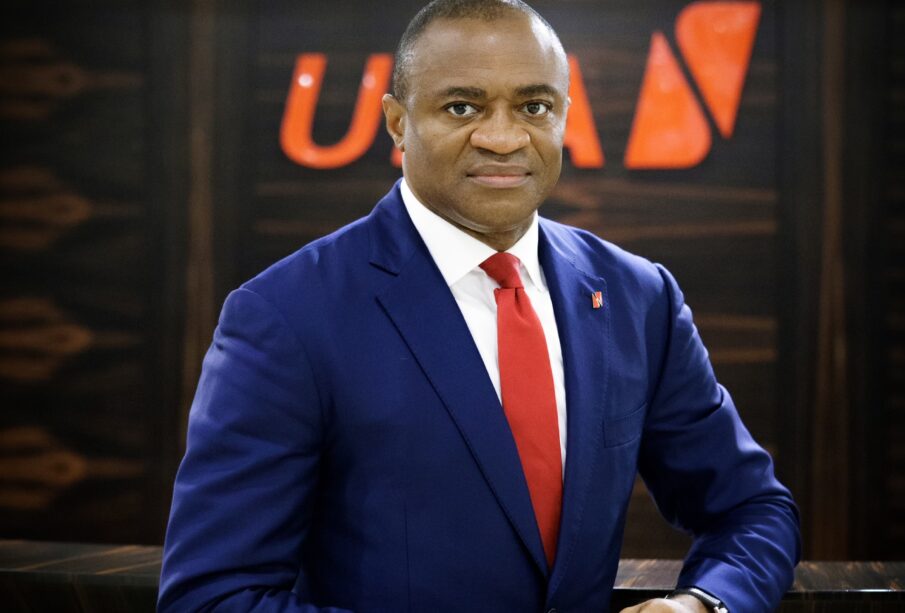
The Group Managing Director of the United Bank for Africa (UBA) Oliver Alawuba, says Africa can bring out enough capital to drive its transformation.
He, however, added that the challenge lies in the misalignment of domestic funding and the lack of credible partnerships.
Alawuba said this on Monday in his the keynote address at the UAE-Chad trade and investment forum held in Abu Dhabi, with the theme, ‘Financing African Competitiveness — Building Bridges, Powering Progress.’
He said Africa’s development story must move beyond the narrative of potential to the phase of execution.
Alawuba commended the Chadian government for its “bold approach” to driving national competitiveness through the $30 billion ‘Chad connection 2030’ plan, which, he said, targets infrastructure, industrialisation, and human development.
He said, “The $30 billion Chad Connection 2030 plan is not just a document; it is a declaration of intent. It is a detailed roadmap to move a nation from the periphery to the very heart of global economic competitiveness”.
Alawuba said the continent must focus on financing large-scale projects such as power grids, infrastructure and digital systems that will unlock inclusive growth and investor confidence.
He added, “It means understanding that a reliable power grid is the foundation of industrial growth. Chad’s target of 60% electrification by 2030 will enable factories to operate, cold chains for agriculture to function, and the digital economy to flourish.
“It means recognizing that water access for 11 million additional people drives economic transformation. Safe water reduces healthcare burdens, enables food processing industries, and unlocks agricultural productivity across the value chain. And it is built with governance that assures an investor that their capital is safe, and their project will be seen through.”
Alawuba now posed a question to his audience, “A plan of this magnitude poses one critical question: How do we finance this future?
He quickly answered, “The answer lies not in a single source, but in a powerful, collaborative model. A model where African financial institutions like UBA step up not as mere intermediaries, but as architects of finance.
“At UBA, we have always believed that the capital to transform Africa exists, both within and outside our continent. The challenge has never been a lack of capital, but a lack of bankable structures and credible partnerships, including huge domestic capital misalignment.
“According to the Africa Finance Corporation (AFC), Africa’s domestic financial assets are estimated to total approximately $4 trillion ($2.5 trillion in Commercial Bank Assets, $725 billion in Foreign Reserves and others, $455 billion in Pension Assets and $320 billion in Insurance Assets), but less than 15% of these assets are currently channelled into productive infrastructure essential for growth. This the gap we bridge,” he said.
The group managing director said UBA has been structuring deals across Africa to de-risk investments and mobilise large-scale capital flows.
In Chad, for instance, he said the bank has made a $100 million direct investment in government securities and continues to support national development projects.
“This demonstrates a deep and vested partnership with Chad’s development agenda. Indeed, true competitiveness requires an inclusive economy. Africa will grow without leaving anyone behind,” Alawuba said.
He called for better mobilisation of Africa’s over $4 trillion in domestic capital, which he said is not currently properly aligned, to attract foreign investment and finance development.
“At UBA, our commitment is two-fold: we are both architects of national infrastructure and champions of grassroots financial inclusion. Here in Chad, this is not a promise; it is a proven track record. We have already committed over $102 million in direct investments in the State of Chad’s securities and have been the lead financier on critical national projects – from a $49 million domestic gas project to bring clean energy to households, to a $6.7 million wind farm in Amdjarass and essential funding for road maintenance and telecom modernization. This demonstrates a deep, vested partnership with Chad’s development agenda.
Transferring the vision to the entire continent, the GMD said Africa’s infrastructure transformation requires partnership with a structure which include international expertise and capital, African institutional banking and Development Finance Institutions (DFIs) like the World Bank and the AfDB – offering de-risking instruments and concessional finance that make projects viable.
He added, “When these elements align, we see meaningful results. Our recent whitepaper, ‘Banking on Africa’s Future,’ launched at the World Bank-IMF Annual Meetings, demonstrates that strategic African anchor investment can attract international capital at a ratio of 10-to-1 or even 20-to-1. For Chad’s $30 billion plan, this multiplier effect is the key that unlocks the vault.
For Chad’s plan, he said UBA is ready to partner in Structuring PPPs for solar plants and water treatment facilities, providing syndicated loans and project finance to connect Chad to regional energy grids, ensuring stable, affordable power for industrial zones, as well as deploying digital payment platforms to support Chad’s E-Tax and e-registry initiatives, making the business climate more transparent and efficient for every investor.
“Let us combine our resources and our skills and stand together to power Chad’s transformation, and in doing so, unlock a new era of African competitiveness,” he added.



Leave a reply


The Editorial is a Platform for factual and precise news updates. Available to the readers 24/7 globally