Marketers kick over Dangote’s fuel distribution plan
Dangote refinery
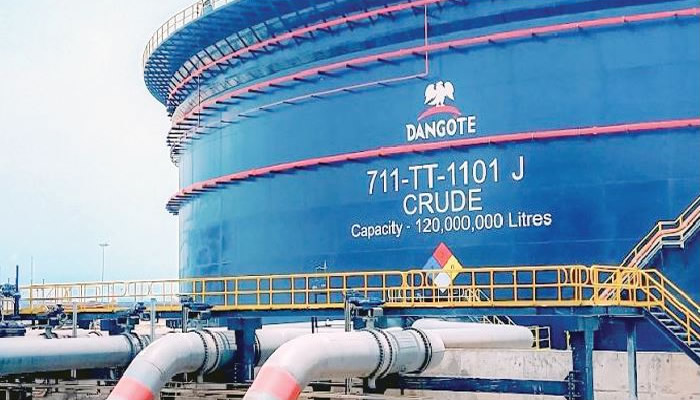
The announcement by Dangote Refinery and Petrochemical Limited to commence fuel distribution directly to marketers, filling stations nationwide is causing disquiet in the oil and gas industry with some marketers fearing the move could disrupt the supply value chain.
Dangote had announced the national distribution of the premium motor spirit (PMS) and diesel to marketers, petrol dealers, manufacturers, telecommunication and aviation firms.
In a statement, the company said the initiative is designed to transform Nigeria’s fuel distribution landscape.
It said the initiative would begin on 15th of August 2025 and to ensure smooth take-off of the scheme, it has invested in the procurement of 4,000 brand-new Compressed Natural Gas (CNG)-powered tankers.
“The refinery will begin the distribution of Premium Motor Spirit (PMS) and diesel to marketers, petrol dealers, manufacturers, telecoms firms, aviation, and other large users across the country, with free logistics to boost the distribution network. This phase of the programme will continue over an extended timeframe and the refinery is also investing in Compressed Natural Gas (CNG) stations, commonly referred to as daughter booster stations, supported by a fleet of over 100 CNG tankers across the country to ensure seamless product distribution.”
According to Dangote, the strategic programme is part of its broader commitment to eliminating logistics costs, enhancing energy efficiency, promoting sustainability and supporting Nigeria’s economic development.
The announcement has triggered a flurry of reactions from marketers with many fuel marketers both major and independent marketers expressing divergent views over the plan.
Some of the marketers said the move could disrupt the market and create a room for monopoly in the petroleum industry which is not good for competition and energy security.
Daily Trust learnt that major energy marketers of Nigeria (MEMAN) and other marketers’ associations are expected to hold strategic meetings this week to deliberate on the development and the general implication for the market.
The Petroleum Products Retail Outlets Owners Association of Nigeria (PETROAN) has kicked against Dangote Refinery’s move to distribute its petroleum products to outlets nationwide.
PETROAN’s national public relations officer, Joseph Obele, said the offer is tantamount to monopoly in disguise.
The statement reads: “The Petroleum Products Retail Outlets Owners Association of Nigeria (PETROAN) has raised concerns about Dangote Refinery’s forward integration adoption, warning that it could lead to a monopoly in disguise and pose a significant job loss threat to Nigeria.
“With a production capacity of 650,000 barrels per day, PETROAN argues that Dangote Refinery should be competing with global refineries, not operating as a distributor in the downstream sector.
“This massive refinery, one of the largest in sub-Saharan Africa, is expected to satisfy domestic fuel demand and export surplus products.”
According to the association, Dangote’s tactics “may include a pricing penetration strategy, where they reduce prices to capture market share, with the ultimate goal of forcing other filling station operators to quit the market.”
“This could lead to a massive shutdown of filling stations across Nigeria, resulting in widespread job losses,” the statement reads.
It warned that the introduction of 4,000 new compressed natural gas (CNG)-powered tankers by Dangote refinery “poses a significant threat to the livelihoods of thousands of truck drivers and owners.”
“While CNG trucks may offer a lower cost of transporting petroleum products, this shift could lead to widespread job losses in the industry,” PETROAN said.
The association said the adoption of the strategy by Dangote refinery will significantly affect various stakeholders, including modular refineries, as their operations and market share may be threatened by Dangote’s dominance.
“Filling Station Operators: Many may be forced to shut down due to Dangote’s pricing penetration strategy and dominance,” the statement reads.
“Local Suppliers of Petroleum Products: Their businesses may be negatively impacted by Dangote’s direct supply to end-users.
“Telecom Diesel Suppliers: Their operations and market share may be threatened by Dangote’s dominance.
“It is obvious that Dangote plans to gain full monopoly of the downstream sector, which would enable the company to exploit Nigeria’s petroleum consumers.”
For the Independent Petroleum Marketers Association of Nigeria (IPMAN), the plan by Dangote should be viewed as one of the benefits of deregulation.
National Publicity Secretary of IPMAN, Chinedu Ukadike in a chat with our correspondent stated that Dangote’s plan is not a bad idea if it is well-intentioned.
He however stated that deploying 4000 tankers on Nigerian roads is not safe, saying it would be better to reactivate the pipelines which connect to various depots across the country.
“We have other better ways of pushing petroleum products. With his new found cooperation with the federal government, we believe he (Dangote) could have used his expertise to fix the pipelines and ensure that his products pass through the pipelines.
“By this it would be easier for us independent marketers to go to the depots and lift the products. We should also look at the hazardous nature of 4000 trucks on our roads given the bad state of the roads and the high accident rate we have been receiving. I think that with time stakeholders would sit down and look at this policy. We are not against it, we are for anything that will ensure energy security…”
Another marketer who spoke with Daily Trust on the condition of anonymity said the idea being mooted by Dangote would run those involved in the distribution of petroleum products out of business.
He said, “You know how Elon musk has disrupted some businesses in the US with his electric vehicles, making batteries and whatever. So obviously the people making cars will not be his biggest fan.
“So anybody who is into the distribution, haulage of petroleum products obviously will not like this development because it’s possible it can mean they are going out of business, particularly those depot owners who don’t have retailers, it’s almost like the end of the road for them, it’s going to be tough for them.
“At the same time Nigeria as a country needs to also be mindful of the way they are going by putting all the power in the hand of one person and that can be dangerous to any country.
“If one person is the dominant player immediately there’s an issue or quarrel and you have driven other players out of the market, if he decides to increase price all the alternatives would have been killed. That is something Nigeria needs to consider very carefully.
“I think the other aspects of it would be that other people who have invested in that value chain may go out of business. Is that a good or bad thing? It depends, if you are a capitalist person you will understand that once there’s a disruption in an industry, they believe some people will go out of business and only the strong will survive. So from that perspective I can’t necessarily say what would happen. It will challenge my own business too or whatever but we will have to brace up to the new dimension and see how we would maneuver to continue to survive.
“Integrated companies or diversified companies who have different aspects, maybe they sell lubricants /aviation fuel, LPG, everything, they may have alternative things to fall back on. The people that will really be hard-hit are those who are just having tanks where people come and buy products, it may be a bit difficult for them to survive.”
Experts said the refinery’s decision to deploy 4,000 brand-new Compressed Natural Gas (CNG)-powered tankers could also dismantle the monopoly held by intermediaries and contribute to a cleaner environment.



Leave a reply


The Editorial is a Platform for factual and precise news updates. Available to the readers 24/7 globally