
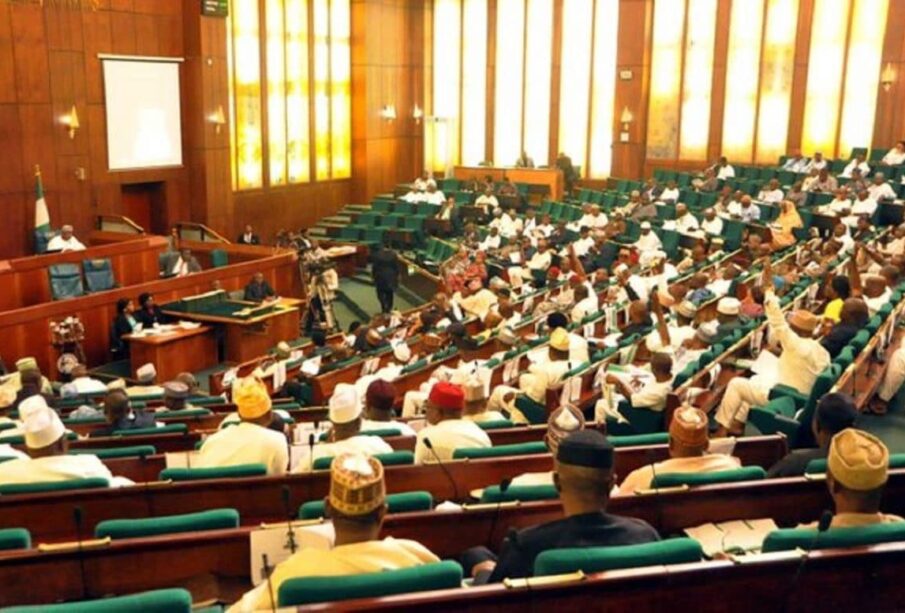
House of Reps
The House of Representatives on Tuesday rejected a bill seeking to amend the 1999 Constitution to mandate the rotation of the offices of the president and vice president among Nigeria’s six geopolitical zones.
Also thrown out was another controversial bill aimed at stripping the Independent National Electoral Commission (INEC) of its constitutional power to register and regulate political parties.
The rotational presidency bill was sponsored by Deputy Speaker Benjamin Okezie Kalu, while the INEC-related bill was jointly sponsored by Speaker Abbas Tajudeen and Hon Francis E. Waive.
The bill titled, A Bill for an Act to Alter the Constitution of the Federal Republic of Nigeria, Cap. C23, Laws of the Federation of Nigeria, 2004 to Provide for the Principle of Rotation of the Offices of the President and the Vice President of the Federal Republic of Nigeria among the Six Geopolitical Zones of the Country, Namely: North Central, North East, North West, South East, South South, and South West and for Related Matters (HB. 2291), was one of seven constitutional amendment proposals listed for second reading on the day’s Order Paper.
However, the proposal was rejected following an extensive debate marked by sharply contrasting views on its implications for national unity, meritocracy, and federalism.
While advocates of the bill said it would foster inclusivity and ensure equitable access to power across the regions, opponents warned it could fuel ethnic rivalry, deepen division, and limit the emergence of competent leaders.
Deputy Speaker Kalu, who presided over the plenary, defended the bill, saying the intention was to ensure that all parts of the country had a fair shot at occupying the highest offices in the land.
He argued that rotational presidency would promote national cohesion and address long-standing complaints of marginalisation, especially from zones like the South East, which have yet to produce a president since Nigeria’s return to civilian rule in 1999.
Kalu dismissed claims that the policy would institutionalise mediocrity.
“Every region of Nigeria has competent people,” he said. “Best of the best cannot be limited by region. If you go to the North East, there are people; the North West, there are people; the North Central, South West, South South, South East—everywhere there are competent individuals. To increase national cohesion and unity is what we are looking at.”
Nonetheless, the debate drew firm opposition from a majority of lawmakers across party lines, who argued that the Constitution already addresses inclusivity through the federal character principle, and that zoning should remain the internal decision of political parties.
The Deputy Minority Leader, Aliyu Madaki (NNPP, Kano) said the bill was redundant, as Section 14(3) of the Constitution already promotes representation of all regions in government.
He added, “The zoning of the presidency should be a matter for political parties to decide. We must prioritise competence over regional considerations.”
Rep Sada Soli (APC, Katsina) described the bill as dangerous and “injurious to national unity.”
“It will develop mediocrity concerns where the system will encourage ethnic and regional affiliation over merit. If a zone has had its shot, others must wait 4 to 8 years, regardless of the calibre of people available. This will cost Nigeria the opportunity to benefit from competent leadership,” he warned.
Soli also raised concerns about manipulation by political elites, saying rotational presidency would increase the potential for elite capture and regional contestation. “It will narrow the pool of leadership candidates and fuel political manipulation by those seeking to rotate power to their advantage.”
Rep Bello El-Rufai (APC, Kaduna) strongly opposed the bill, citing Nigeria’s ethnic diversity and warning that codifying regional power rotation in the Constitution would worsen identity politics.
“Nigeria has over 400 ethnic groups. If you start zoning the presidency, every tribe in every state will start making claims. It sets a dangerous precedent. Democracy is not perfect, but it remains our best option,” he said.
El-Rufai acknowledged the sense of injustice expressed by proponents but attributed it to governance failures rather than structural exclusion.
“We must focus on governance and social equity. There’s no constitutional barrier stopping anyone from any region from contesting. The solution is not rotation but a level playing field where the best candidate can emerge.”
Still, some lawmakers endorsed the bill, urging the chamber to consider the historical imbalances in leadership.
Rep Ali Isah (PDP, Gombe) supported the bill and called for its expansion to cover state-level governance.
“We should ensure that all zones within every state also get a chance to produce governors. This will instil fairness and a stronger sense of belonging,” he said.
Rep Clement Jimbo (APC, Akwa Ibom) echoed similar sentiments, arguing that the bill sought to correct historical injustices faced by minority regions.
“This bill is meant to cure an age-long injustice,” Jimbo said. “If we allow free competition for the presidency, minority zones will never have a fair chance. But after every region has had its shot, the rotation should end, and leadership should be based purely on competence.”
However, Rep Shina Oyedeji disagreed, saying democracy is inherently about open competition.
“Zoning and regional sentiments negate democratic principles. Everyone should have an equal opportunity to contest at any time,” he argued.
Following the extended debate, Kalu, in his role as presiding officer, put the bill to a voice vote.
When the “nays” were louder than the “ayes,” he repeated the vote for confirmation. With the opposition still outweighing support, he ruled the bill had been rejected.
The other six constitution amendment bills on the Order Paper also failed to scale second reading.



Leave a reply


The Editorial is a Platform for factual and precise news updates. Available to the readers 24/7 globally