
Rivers Crisis: Why I Choose to Be Weak — Fubara
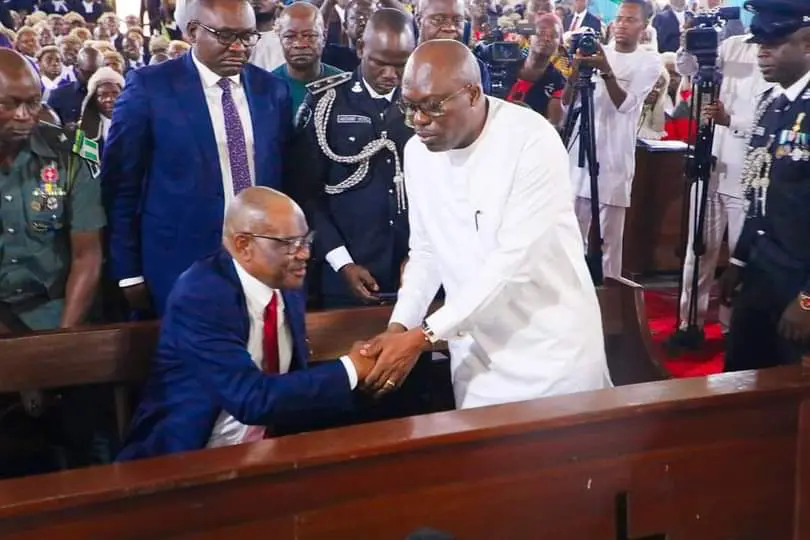
Fubara and Wike
Governor Siminalayi Fubara of Rivers State says his decision to appear “weak” in the face of political pressure is a deliberate choice aimed at preserving peace and stability in the state.
Fubara spoke while receiving the 2025 Man of the Year Award presented to him by New Telegraph.
In a speech that dwelt on the burdens of leadership, the toll of political conflict and the need for reconciliation, the governor dedicated the award to his predecessor, Nyesom Wike, who currently serves as minister of the Federal Capital Territory (FCT).
“I do not care how you interpret it or misinterpret it. I also dedicate this award to somebody who discovered me, not minding the situation — the honourable minister of FCT, Nyesom Wike,” Fubara said.
“He discovered me, and it is the discovery that gave me this loudness. Today is a very special day, and also special for everyone who has believed in me, and I know that for believing in me, you have a share of special pain.”
The governor said the challenges he and his supporters have endured have been interpreted in different ways, but insisted his posture is intentional.
“Some people have described these pains as weakness, while others say it is being strong. But I choose to be weak for a lot of reasons — weak because I want peace, weak because we need to survive,” he said.
“Weak because I need to also protect those things that are dear, not just to me, but to our dear nation. Weakness is a virtue. It pays at the right time.”
Fubara also thanked his family and the people of Rivers State for what he described as their patience and maturity amid the prolonged political crisis in the state.
Last week, President Bola Tinubu intervened to broker peace between the governor and the Rivers State House of Assembly after months of tension marked by impeachment threats and a divided legislature.
A majority of the lawmakers in the assembly are considered loyal to Wike.
The former governor has recently campaigned against Fubara’s re-election bid, accusing him of reneging on a peace agreement they allegedly signed before Tinubu lifted the emergency rule earlier imposed on the state.
In his latest Daily Trust column, Monima Damanibo, analysed the ongoing developments in Rivers.
Some of the questions he asked in the piece entitled: “Fubara: Where is ‘people power’ in your strategy?” have been answered by the governor.
“Once more, the governor of Rivers State, Siminalayi Fubara Thursday dissolved the state’s Executive Council. This development was not due to any other publicly known reason other than to placate his traducers, comprising some restive members of the Rivers State House of Assembly (RSHA), who are loyal to Nyesom Wike, his predecessor in office and now minister of the Federal Capital Territory (FCT),” he wrote.
“It is easily recalled that some days ago, this situation was cited as one of the conditions demanded by the Wike camp during a peace meeting brokered by President Bola Tinubu between him and Fubara. This development is coming as another concession to Wike by Fubara, but which has implications beyond whatever personal interests they may have. Even in its most basic context, dissolution of a state executive council constitutes a tacit decapitation of a governance dispensation; hence it is not an exercise that is undertaken casually.
“Among the Kalabari and other Ijaw ethnic nationalities, leadership in the traditional context is a serious dispensation involving rituals, each of which on its own conveys clear-cut messages to the incumbent on expectations of him by the community. One of such rituals that mark the emergence of a chief or king is his moment of choice, whereby he has to choose between a cannon ball, which signifies his disposition towards war to defend his community if necessary and a tuber of yam, which also signifies his willingness to provide for his people. It is understandable that in the statutory context, all such obligations are rolled into the constitutional oath, which is administered to the incumbent in the course of coming into office.
“As the first democratically elected governor of Ijaw extraction in Rivers State since the days of Melford Okilo in 1979 and Rufus Ada George in 1990, Siminalayi Fubara remains seen by not a few Ijaw people from the prism of the obligations of an Ijaw chieftain, who, by virtue of the oath of cannon ball and tuber of yam, is sworn to defend, protect and provide for his constituents. It is also in the same context that not a few observers are watching the ongoing battle of wits between him and Nyesom Wike, his immediate predecessor as governor of the state and an implacable traducer-in-chief, with the latest instance of dissolving his cabinet at the instance of his traducers as one concession too many.
“In their three-year-long running and daily convoluting contest for control of the political power structure, as well as vast resources of the state, both Fubara and Wike have left the public guessing at every turn of the melee, on the next move by any of them in order to outsmart the other. So far, Wike had been the implacable aggressor, fighting from ‘outside’ to dislodge the incumbent Fubara, including dangling the unsettling agenda of denying the latter the opportunity to contest for a second term in office come 2027.
“Meanwhile, Fubara, who has so far played the underdog, has survived through a cocktail of deft maneuvers, calm demeanor and capitalising on the slips by his traducer. And by latest count, President Bola Tinubu had intervened for the third time, ostensibly to foster peace between them and allow the state, which had borne the burden of instability in governance, a deserved respite from the crisis.”


Leave a reply


The Editorial is a Platform for factual and precise news updates. Available to the readers 24/7 globally