
Tony Elumelu lists ways to Africa’s development, greatness
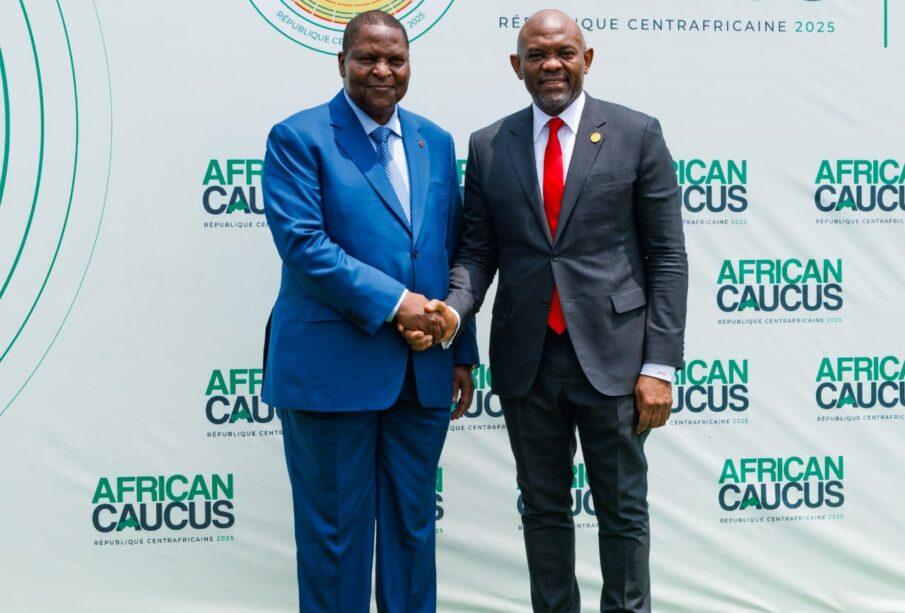
President, Central African Republic, Faustin-Archange Touadéra and Group Chair, UBA and Heirs Holdings and Founder, Tony Elumelu Foundation, Mr. Tony Elumelu
The Group Chair, Heirs Holdings and the United Bank for Africa, Mr Tony Elumelu has charged African leaders to invest in the youths, prioritise energy infrastructure without which nothing much can be done, as well as take full responsibility for the development of the continent.
Elumelu, also the Group Chairman of Transcorp and founder of The Tony Elumelu Foundation, spoke at the African Caucus Meeting of World Bank and IMF in Bangui, Central African Republic with the theme, ‘Resilient Infrastructure, Human Capital, and Green Assets.’
A copy of his address was made available to theeditorial.ng on Thursday in Lagos.
In the keynote address titled, ‘Resilient Infrastructure, Human Capital, and Green Assets,’ Elumelu notes that Africa’s infrastructure gap is a major obstacle to the continent’s progress.
“Across our continent, we face a deep and persistent infrastructure gap. From roads to ports, power to internet connectivity – we lag behind. We cannot achieve prosperity without the foundations of modern development. Without addressing these gaps, we cannot unlock the growth and prosperity our people deserve.
The foremost African philanthropist pointed out that to bridge the divide, Africa must “strengthen our fiscal capacity, drive efficiency and unlock innovative financing – especially by inviting and enabling private sector to co-lead infrastructure development.”
Elumelu also highlighted the importance of energy access in driving Africa’s industrialisation and economic growth. He noted that up to 70 per cent of Africans lack electricity, and that his home country, Nigeria, generates less than 7,000 megawatts for over 200 million people.
“If we are to industrialise, create jobs, and participate meaningfully in the global AI revolution, we must invest aggressively in energy — from renewables to cleaner gas-based solutions,” he said.
He said through investments in Transcorp and Heirs Energies, he and others are working to solve Africa’s energy challenge.
“We are generating power, exporting it through the West African Power Pool, and using gas from our oil operations to power our plants,” he said, adding that such is an example of Africapitalism in action — private capital solving public challenges.
Elumelu also emphasised the importance of investing in Africa’s youth.
“No resource is more valuable than our people — especially our youth,” he said, explaining that through the Tony Elumelu Foundation, over 24,000 young entrepreneurs across all 54 African countries had been empowered, 1.5 million youths were trained, while 1.2 million jobs had been catalysed.
“These entrepreneurs are creating jobs, building businesses, and changing lives.
“If empowered, our youth can transform Africa. If neglected, they can become a source of instability.”
He emphasised the need for African governments to strengthen their fiscal capacity, drive efficiency, and unlock innovative financing to solve challenges.
“We must also be realistic. African governments must do better. If we are to deliver that opportunity to our next generation – and if we are to be truly heard in the community of nations, Africa needs to step up.
“This global community has not always served Africa interests, ensured that Africa’s voice is heard or delivered for Africa.
“And Africa’s voice not only needs to be heard, but has to be heard.
“… Governments must create the right environment. Private sector must bring capital and innovation. And our development partners must support Africa’s realities.”
In his call to action, Elumelu said, “Africa’s development is our responsibility. No one else will do it for us. Africa’s future is in our hands. No one will build this continent for us. We must lead.
“Power is everything. No industrial revolution can happen without electricity. We must prioritise energy. Without power, there can be no progress.
“We must invest in our youth. They are not just our future – they are our present.
“Together, by working across public and private sectors, and in partnership with institutions like the IMF and World Bank, we can build an Africa that is resilient, inclusive, and full of opportunity.”


Leave a reply


The Editorial is a Platform for factual and precise news updates. Available to the readers 24/7 globally